History & architecture
Palma Cathedral history: who built La Seu, and why it took 400 years
Palma Cathedral’s history has better plot twists than most novels: a conquering king started it in 1229 on the site of a mosque, anonymous masons finished it in 1601, an earthquake rewrote its facade, Gaudí rearranged its heart, and Miquel Barceló added the final chapter in 2007. Here are the facts, the timeline and what makes this Gothic different.
ⓘ Independent guide. Not the cathedral’s official website.The short answers first
What is it called? Officially, Catedral-Basílica de Santa María de Mallorca. Locals say La Seu — Catalan for “the see”, the bishop’s seat. Maps and tickets also use Palma Cathedral, Mallorca Cathedral and Catedral de Palma. One building, four names.
Who built it? It was begun under King Jaume I of Aragon after he conquered Mallorca in 1229, then raised by generations of master masons over nearly four centuries, until 1601. Most of them are anonymous; the standout name is Guillem Sagrera, the 15th-century sculptor-architect behind the Portal del Mirador.
Where does it stand? On the site of the great mosque of Madina Mayurqa — Muslim-era Palma — at the most visible point of the city: on top of the sea walls, next to the royal palace of La Almudaina, facing the bay.
Timeline: 1229 to 2007
| Year | What happened |
|---|---|
| 1229 | Jaume I takes Madina Mayurqa. The great mosque is consecrated for Christian worship and a cathedral is planned on its site. |
| 13th–16th c. | Construction in stages: east end, chapels, then the 44-metre nave on fourteen columns. In the 15th century Guillem Sagrera sculpts the Portal del Mirador. |
| 1601 | The work is declared complete — almost four hundred years after the conquest. |
| After 1851 | The 1851 earthquake damages the west front; the main facade is rebuilt in neo-Gothic style over the 19th century — the one you photograph today. |
| 1904–1914 | Antoni Gaudí’s renovation: the choir moves to the sanctuary and his wrought-iron baldachin is hung over the high altar. |
| 2007 | Miquel Barceló completes his ceramic mural of around 300 m² in the Chapel of the Blessed Sacrament — the contemporary chapter. |
1229: a king, a conquest and a vow
The story starts at sea. In 1229 Jaume I of Aragon landed on the island and took Madina Mayurqa, Mallorca’s Muslim capital. Tradition says he vowed to dedicate a church to Saint Mary after surviving a storm on the crossing; what is certain is that after the conquest the great mosque was consecrated for Christian worship, and the cathedral began to rise in its place.
The location says everything about intent: perched on the sea walls above the harbour, shoulder to shoulder with La Almudaina — the Moorish citadel turned royal palace. This was power architecture, built to be read from the water, and eight centuries later it is still the first thing you see arriving in Palma by boat.
Four centuries of building: why it took so long
Gothic cathedrals were built in campaigns, at the pace of money and stone. First the east end with the Trinity Chapel — where kings Jaume II and Jaume III now lie — then the Royal Chapel, then, bay by bay, the vast nave. Each generation of masons inherited the plans, adjusted them and died before the roof closed. The work was finally declared complete in 1601.
One name rises above the anonymous army: Guillem Sagrera, the finest architect-sculptor of Mediterranean Gothic, who worked on the cathedral in the 15th century and carved the Portal del Mirador, the great doorway facing the sea. His other masterpiece, Palma’s Llonja, stands ten minutes away and makes the perfect follow-up walk.
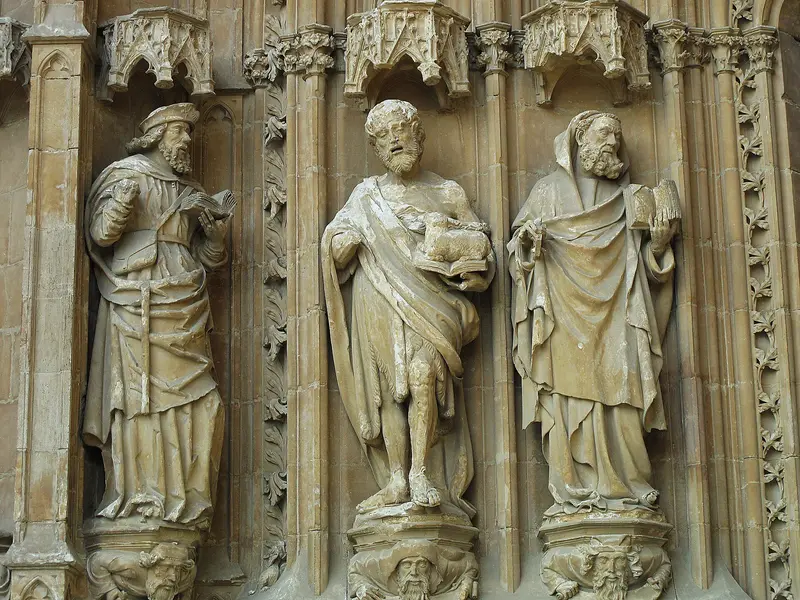
Levantine Gothic: Gothic with Mediterranean light
La Seu is the high point of Levantine Gothic, the Mediterranean take on the style, and the difference is concrete:
- Width over vertigo: broad naves and slender columns — fourteen, octagonal — create one continuous space rather than the narrow, soaring corridors of French Gothic.
- Light as a building material: the walls are pierced to the limit. The great rose window, about 12 metres across with over 1,100 pieces of glass, is among the largest in Gothic architecture — locals call it “the Gothic eye”.
- Massive external buttresses: the thrust of the 44-metre nave lands on the rank of buttresses along the south, sea-facing facade — which is why La Seu reads like a carved cliff from the Parc de la Mar.
You grasp it faster standing inside than reading any book: a nave taller than Notre-Dame that doesn’t crush you — it floats. The interior guide walks you through it piece by piece.
The neo-Gothic facade: the 1851 earthquake
The main facade you photograph from Plaça de la Seu is not medieval. After the earthquake of 1851 badly damaged the west front, the facade was rebuilt in neo-Gothic style over the course of the 19th century. That is why its stonework looks crisper and more regular than the Portal del Mirador, which keeps its original 15th-century carving.
The 20th and 21st centuries: Gaudí and Barceló
Between 1904 and 1914, Bishop Campins brought in Antoni Gaudí to rethink the interior. Gaudí moved the choir stalls from the middle of the nave into the sanctuary — handing visitors back the full sweep of the church — and suspended his wrought-iron baldachin, a crown of metal and light, over the high altar. He walked away in 1914 with the project unfinished, but he changed how the building is experienced for good.
The latest chapter came in 2007, when Mallorcan artist Miquel Barceló covered the Chapel of the Blessed Sacrament with some 300 square metres of ceramic on the miracle of the loaves and fishes. Eight centuries in, the cathedral is still collecting layers: Gothic, neo-Gothic, Modernisme and contemporary art under one roof. No other European cathedral closes that circle.
La Almudaina: the neighbour that completes the story
To make sense of 1229, cross the square: the Royal Palace of La Almudaina — the Moorish citadel turned palace of the Kings of Mallorca — stands two minutes from the cathedral and tells the other half of the story, crown beside mitre. It takes under an hour to visit, and tickets are bookable online. For the rest of the neighbourhood, see what’s nearby.
See it with your own eyes
Everything on this page is visible in a single 60–90 minute visit: 14th-century Gothic in the nave, Sagrera’s 15th century at the Portal del Mirador, the 19th on the facade, Gaudí over the altar and Barceló in his chapel. Book a skip-the-line ticket from €11, arrive at 10:00 for the rose-window light and check the opening hours first — there are no tourist visits on Sundays. Visiting on 2 February or 11 November? Get up early for the Festa de la Llum.
Frequently asked questions about La Seu’s history
Who built Palma Cathedral?
No single builder: construction began under King Jaume I of Aragon after his conquest of Mallorca in 1229, and generations of master masons carried it forward for nearly four centuries, until 1601. The most famous name among them is Guillem Sagrera, the 15th-century architect and sculptor of the Portal del Mirador.
What is Palma Cathedral actually called?
Its official name is Catedral-Basílica de Santa María de Mallorca. Locals call it La Seu — Catalan for “the see”, the bishop’s seat. You will also find it as Palma Cathedral, Mallorca Cathedral or Catedral de Palma. All names point to the same building.
How long did the cathedral take to build?
Almost four hundred years: from 1229, after Jaume I’s conquest, until 1601, when the work was declared complete. Even then it kept evolving — the main facade was rebuilt in the 19th century after the 1851 earthquake, Gaudí renovated the interior between 1904 and 1914, and Barceló added his ceramic chapel in 2007.
What stood on the site before?
The great mosque of Madina Mayurqa, as Palma was known under Muslim rule. After the conquest of 1229 the mosque was consecrated for Christian worship, and the new Gothic cathedral gradually replaced it on the same spot, right beside the royal palace of La Almudaina.
What architectural style is La Seu?
Levantine (Mediterranean) Gothic: wide naves, slender columns, a single luminous space and lots of light, in contrast with the dim verticality of northern Gothic. The main facade is different — neo-Gothic, rebuilt in the 19th century — and inside you also get Gaudí’s Modernisme and Barceló’s contemporary ceramics.
What did Gaudí do to the cathedral?
Between 1904 and 1914 he directed an interior renovation: he moved the choir stalls out of the middle of the nave into the sanctuary, opening up the view of the whole church, and hung his wrought-iron baldachin over the high altar. He left in 1914 with the project unfinished.
Can you visit the cathedral today?
Yes: Monday to Friday 10:00–17:15 and Saturday 10:00–14:15 (Sundays are worship only). Tickets start at €11 online, include the Museum of Sacred Art and let you skip the box-office queue. Children under 10 go free.
Facts last reviewed: August 2026. Cross-checked with the official site (catedraldemallorca.org) and Tiqets.