What to see inside
Inside Palma Cathedral: what to see, chapel by chapel
Inside Palma Cathedral you get Spain’s largest Gothic rose window, a nave taller than Notre-Dame, a canopy forged under Antoni Gaudí and 300 square metres of ceramic by Miquel Barceló — all under one roof. Here is exactly where to look, in what order, and when the light does its trick.
ⓘ Independent guide. Not the cathedral’s official website.The route in order: seven stops
The visitor route runs one way, from the entrance towards the east end and back along the nave. Follow it in this order — the best pieces are at the far end, so pace yourself and don’t burn your time by the door.
- The nave: stop just inside and look up. Forty-four metres, fourteen columns.
- The great rose window: face the east end. Locals call it “the Gothic eye”.
- High altar and Gaudí’s canopy: the wrought-iron crown suspended over the sanctuary.
- Chapel of the Blessed Sacrament: Miquel Barceló’s ceramic mural, right of the east end.
- Trinity Chapel: the tombs of kings Jaume II and Jaume III, behind the altar.
- Portal del Mirador: the sea-facing Gothic doorway by Guillem Sagrera — best admired from outside afterwards.
- Museum of Sacred Art: included in your ticket; save it for last.
The great rose window: the Gothic eye
This is the piece the cathedral is famous for: roughly 12 metres across, filled with more than 1,100 pieces of stained glass held in stone tracery above the high altar. Among the world’s Gothic rose windows very few match it for size; in Spain, none do.
Timing is everything. The window faces east, so arrive at 10:00 when the doors open: all morning the sun burns through it and spills reds, blues and golds down the columns and across the floor. By noon the projection fades and you are looking at a beautiful window rather than a light show. Check the opening hours before you plan the morning.
Twice a year — 2 February and 11 November — the rising sun shoots straight through and projects a perfect copy of the window beneath the west rose: two discs of light stacked into a glowing figure of eight. That is the Festa de la Llum, and it is free to watch.
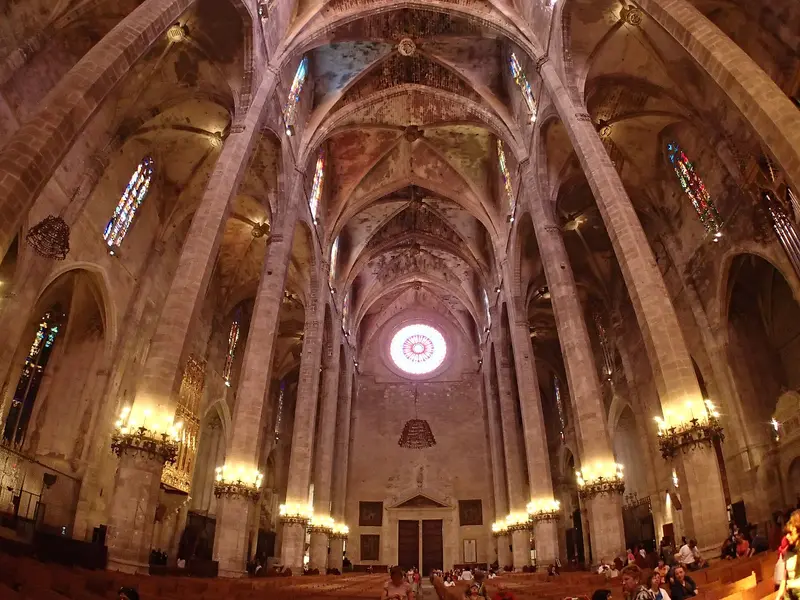
A 44-metre nave on fourteen columns
The central nave rises to 44 metres — taller than Notre-Dame in Paris — carried by just fourteen octagonal columns so slim they look like they shouldn’t work. That is Levantine Gothic in one glance: instead of heavy walls and gloom, a wide, open hall flooded with Mediterranean light. More on the style in the history guide.
Photographer’s tip: stand on the central axis near the west end and frame the columns and the rose window in one shot. And give the side windows a minute — dozens of stained-glass panels keep re-colouring the nave as the day moves on. More angles in the photo guide.
Gaudí’s canopy over the high altar
Between 1904 and 1914 Antoni Gaudí directed a renovation that changed how the cathedral reads from the inside. His boldest move was relocating the choir stalls out of the middle of the nave and into the sanctuary — which is why, unusually for a Spanish cathedral, you can see the whole church the moment you walk in.
His most visible legacy is the wrought-iron baldachin, a glowing crown of metal and lamps suspended over the high altar beneath the rose window. Gaudí left the project in 1914, and the canopy remains his signature on Mallorca — a flash of Modernisme inside a 14th-century Gothic shell. The full story of the renovation is on the history page.
The Barceló chapel: a sea in ceramic
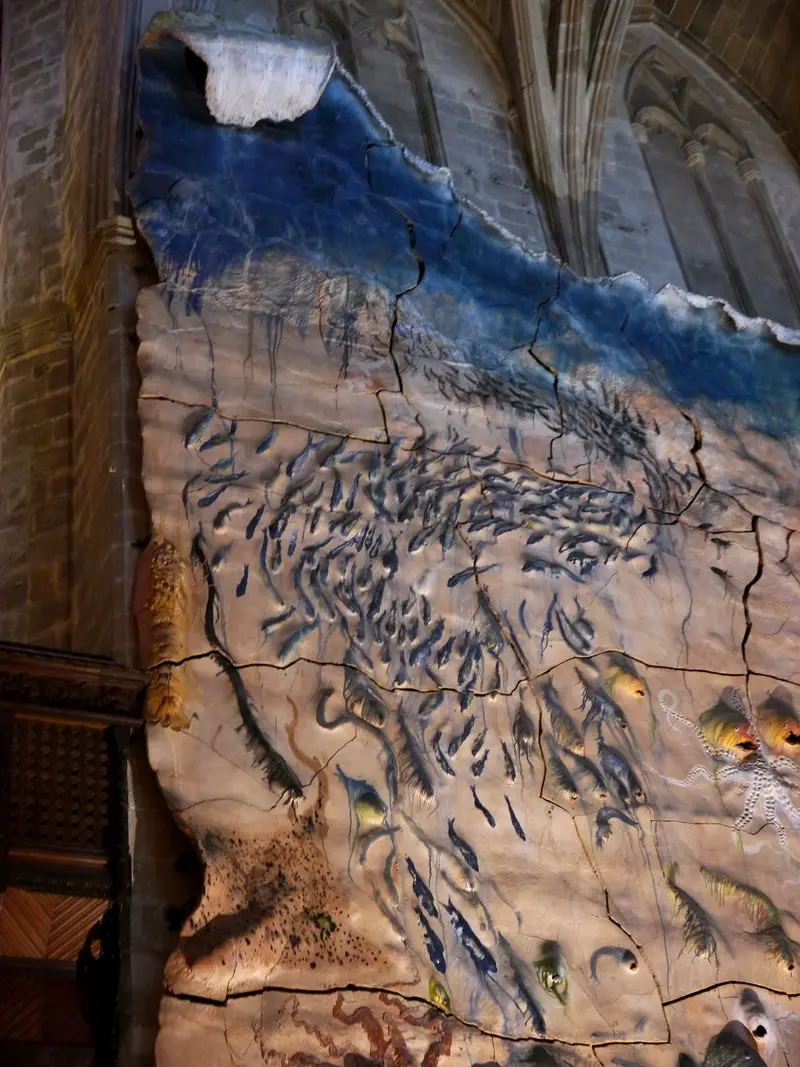
In 2007 the Mallorcan artist Miquel Barceló wrapped the Chapel of the Blessed Sacrament in a ceramic mural of around 300 square metres on the miracle of the loaves and fishes. It is not a painting on a wall — it is fired clay climbing the walls like a reef. The ceramic cracks, bulges and folds into waves; fish, loaves and fruit push out of it as if the sea had set mid-motion.
Visitors split over it — some are floored, some baffled — which is exactly why it deserves ten minutes rather than two. Get close: the texture, somewhere between seabed and lava field, does not survive in photos. No other Gothic cathedral holds a contemporary work on this scale, and it is covered by the standard ticket.
Royal tombs in the Trinity Chapel
Raised behind the high altar sits the Trinity Chapel, the oldest part of the east end. It holds the tombs of Jaume II and Jaume III — the son of the conquering king, and the last monarch of the independent Kingdom of Mallorca. The chapel itself is off-limits, so you view it from the route; even so, few cathedrals put two medieval kings in your sightline.
Sagrera, the Portal del Mirador and the museum
Guillem Sagrera — the master of Mallorcan Gothic, builder of Palma’s Llonja — worked on the cathedral in the 15th century. His masterpiece here is the Portal del Mirador, the sculpted doorway facing the sea. You will pass it on the route, but it reads best from outside: after your visit, walk around the south facade and give it five slow minutes.
Before leaving, do the Museum of Sacred Art, included in your ticket — Gothic panel paintings, silverwork and pieces from the cathedral treasury, comfortably seen in twenty minutes. Craving a view from above? The terraces are a separate, seasonal visit sold only by the official website.
The interior in numbers
| Nave height | 44 m (taller than Notre-Dame in Paris) |
|---|---|
| Columns | 14, octagonal |
| Great rose window | ≈12 m across, over 1,100 pieces of glass |
| Gaudí’s canopy | Wrought iron, from the 1904–1914 renovation |
| Barceló mural | ≈300 m² of ceramic, Chapel of the Blessed Sacrament (2007) |
| Time needed | 60–90 min including the Museum of Sacred Art |
Quick tips before you go in
- Go early: at 10:00 you get the rose window at full colour and a half-empty church; tour groups peak from 11:00 to 14:00.
- Book online: a dated skip-the-line ticket takes you past a box-office queue that hits 30–45 minutes in summer.
- Dress for a church: covered shoulders, no beachwear — the dress code applies in August too.
- Not on Sundays: worship only, no tourist visits. Plan Monday to Saturday and remember last entry is 45 minutes before closing.
One last push: don’t leave this as a “maybe if we walk past”. The interior is why La Seu scores 4.6/5 across nearly 4,000 reviews, and the gap between seeing it in morning light and shuffling through between two cruise groups is enormous. Pick a date, be there at opening, and give it the full ninety minutes.
Frequently asked questions about the interior
What are the must-sees inside Palma Cathedral?
Four stops: the great rose window (around 12 metres across, over 1,100 pieces of glass), the 44-metre nave with its fourteen slender columns, Gaudí’s wrought-iron canopy above the high altar, and Miquel Barceló’s ceramic mural in the Chapel of the Blessed Sacrament. You can cover all four in an unhurried hour.
Is the Barceló chapel included in the standard ticket?
Yes. The Chapel of the Blessed Sacrament is part of the normal visitor route at the east end of the cathedral. The standard ticket (from €11 online) covers the mural, the whole church and the Museum of Sacred Art — no separate ticket needed.
When is the light through the rose window at its best?
First thing in the morning. The window faces east, so from opening at 10:00 the sun pours through it and scatters colour across the stone; by midday the effect fades. On 2 February and 11 November (the Festa de la Llum) the rising sun projects the window onto the west wall, forming a figure of eight with the west rose.
How long does the interior take?
Allow 60–90 minutes for the cathedral plus the Museum of Sacred Art, audio guide included. In a pinch, 45 minutes covers the rose window, nave, Gaudí canopy and Barceló chapel. Last entry is 45 minutes before closing.
Can you see the tombs of the Kings of Mallorca?
The tombs of Jaume II and Jaume III are in the Trinity Chapel, raised behind the high altar. Access to the chapel itself is restricted, so you view it from the visitor route — still worth the stop, as these are the kings of medieval Mallorca.
Can I see the interior for free by attending Mass?
You can attend Mass for free, but you stay in the worship area: no wandering the chapels, no lingering at the Barceló mural, no museum. For a proper look at the interior you need the tourist ticket, Monday to Saturday.
Is the cathedral interior wheelchair accessible?
Yes — the cathedral and museum visit is listed as wheelchair accessible on the Tiqets product page. The terraces are not: they involve 150+ steps and are sold separately, only through the official website.
Facts last reviewed: August 2026. Cross-checked with the official site (catedraldemallorca.org) and Tiqets.